
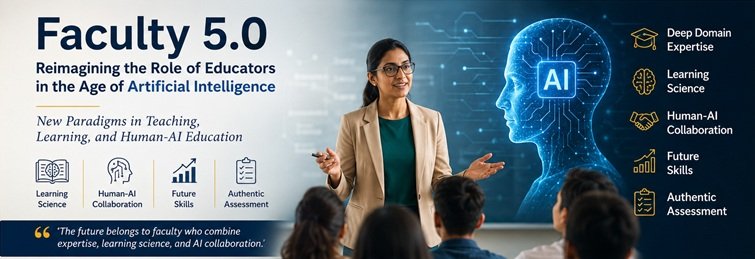
Introduction: A Defining Moment for Higher Education
Higher education stands at a historic crossroads.
Over the past few decades, universities have witnessed multiple waves of transformation—globalization, digitization, online learning, outcome-based education, and the rapid rise of industry-academia collaborations. However, none of these developments have challenged the traditional role of faculty as profoundly as Artificial Intelligence.
The emergence of generative AI tools capable of writing essays, generating code, creating presentations, solving problems, conducting research, and answering questions instantly has forced educators across the world to confront a fundamental question:
What kind of faculty member remains indispensable when knowledge is available at the click of a button?
This is not merely a technology question.
It is an educational question.
More importantly, it is a question about the future purpose of universities.
For centuries, universities were built on the premise that knowledge was scarce. Faculty members were the primary source of expertise, and classrooms were designed around the transmission of information. Today, information is abundant, accessible, and increasingly generated by intelligent machines.
In such a world, the value of education can no longer lie solely in content delivery.
The future of higher education will belong to institutions that move beyond teaching information and focus instead on developing competence, judgment, creativity, adaptability, and lifelong learning capabilities.
This shift requires a new paradigm of educators—what we call Faculty 5.0.
The Changing Question in Higher Education
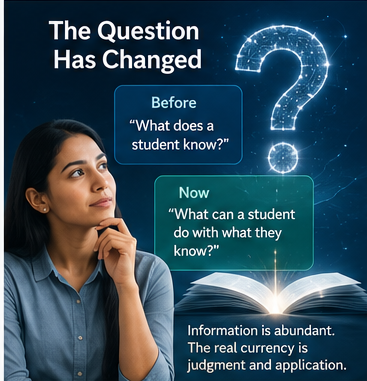
Traditionally, educational success was measured through a relatively simple question:
“What does the student know?”
Examinations tested recall. Lectures focused on content coverage. Academic achievement was largely determined by the ability to reproduce information.
However, the world of work has changed dramatically.
Employers today are less interested in what graduates know and far more interested in what they can do with what they know.
Organizations increasingly seek individuals who can:
- Solve complex problems
- Analyze ambiguous situations
- Collaborate across disciplines
- Communicate effectively
- Learn continuously
- Adapt to rapid technological change
- Exercise sound judgment
In other words, the focus has shifted from knowledge acquisition to capability development.
Unfortunately, many educational systems continue to operate using assumptions developed for the industrial age rather than the knowledge economy.
The gap between what universities measure and what employers value continues to widen.
Faculty 5.0 emerges as a response to this challenge.
Understanding How Learning Actually Happens
One of the greatest misconceptions in education is the assumption that teaching automatically results in learning.
Research in cognitive psychology tells a different story.
Students often spend countless hours attending lectures, taking notes, and rereading textbooks, yet struggle to retain knowledge over the long term.
Why?
Because learning is governed by the architecture of the human brain.
Cognitive Load Theory: Designing for Learning, Not Information Delivery
Educational psychologist John Sweller’s Cognitive Load Theory transformed our understanding of learning by demonstrating that human working memory is limited.
When instructional design overwhelms this capacity, learning becomes difficult regardless of student intelligence or motivation.
The theory identifies three types of cognitive load:
Intrinsic Load – the inherent complexity of the subject matter.
Extraneous Load – unnecessary mental effort caused by poor instructional design.
Germane Load – productive cognitive effort devoted to understanding and schema formation.
This has profound implications for educators.
The role of faculty is no longer simply to deliver content. It is to design learning experiences that minimize unnecessary cognitive burden while maximizing meaningful learning.
Faculty 5.0 educators understand that effective teaching is not about saying more. It is about helping students process, organize, and apply knowledge effectively.
Why Learning Science Matters More Than Ever
Modern learning science provides powerful insights into how durable learning occurs.
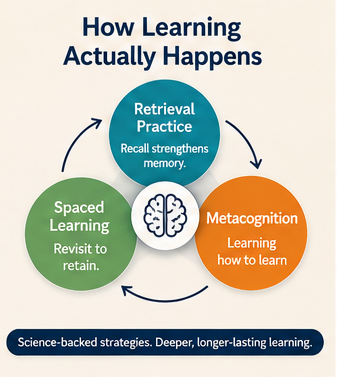
Retrieval Practice: Learning Through Recall
One of the strongest findings in cognitive science is that memory strengthens when learners actively retrieve information.
Contrary to popular belief, rereading notes repeatedly is not an effective learning strategy.
When students attempt to recall concepts from memory, answer questions, explain ideas, or engage in self-testing, neural pathways become stronger.
Faculty 5.0 educators therefore integrate:
- Frequent low-stakes quizzes
- Reflection exercises
- Knowledge checks
- Classroom discussions
- Retrieval-based assessments
Learning becomes active rather than passive.
Spaced Learning and the Forgetting Curve
Another powerful principle is spaced repetition.
Students often engage in massed practice—commonly known as cramming.
While cramming may support short-term recall, knowledge is quickly forgotten.
Research consistently demonstrates that concepts revisited periodically over time are retained significantly longer.
This means curriculum design must evolve.
Rather than treating topics as isolated units, Faculty 5.0 educators deliberately revisit key concepts throughout the semester, strengthening retention and transfer of learning.
Metacognition: Teaching Students How to Learn
Perhaps the most important skill for the future is metacognition—the ability to think about one’s own thinking.
High-performing learners continuously:
- Plan their learning
- Monitor understanding
- Identify knowledge gaps
- Evaluate progress
- Adjust strategies
Yet most universities teach subjects without teaching students how learning itself works.
Faculty 5.0 educators intentionally cultivate self-directed learners capable of thriving in rapidly changing environments.
Human-AI Collaboration: The New Educational Imperative
Much of the discussion surrounding AI focuses on replacement.
Will AI replace faculty?
Will AI replace classrooms?
Will AI replace universities?
History suggests a different outcome.
Technology rarely eliminates human value.
Instead, it changes where human value resides.
The calculator did not eliminate mathematicians.
Search engines did not eliminate researchers.
Similarly, AI will not eliminate educators.
However, it will transform the nature of educational work.
The Human-AI Augmentation Model
The future is not Human versus AI.
The future is Human plus AI.
Artificial Intelligence can:
- Retrieve information
- Summarize content
- Generate drafts
- Create assessments
- Analyze data
- Automate repetitive tasks
Humans contribute:
- Context
- Ethics
- Empathy
- Creativity
- Judgment
- Inspiration
- Mentorship
Together they create what may be called Augmented Intelligence.
The faculty role therefore shifts from content provider to learning designer, mentor, coach, facilitator, and capability builder.
Bloom’s Taxonomy in the AI Era
Bloom’s Taxonomy has guided educational practice for decades.
Traditionally, students spent considerable effort on lower-order cognitive activities such as remembering and understanding.
Today, AI performs many of these functions effortlessly.
A student can instantly generate explanations, summaries, and examples.
This fundamentally changes educational priorities.
Faculty must increasingly design learning experiences focused on higher-order capabilities:
Analyse
Identifying patterns, evaluating evidence, and examining assumptions.
Evaluate
Exercising judgment, making decisions, and considering ethical implications.
Create
Developing original solutions, innovations, and interdisciplinary ideas.
The future classroom will be defined less by information transfer and more by inquiry, reflection, discussion, and creation.
Industry 5.0 and the Future Graduate
Industry 4.0 emphasized automation, digitization, and smart technologies.
Industry 5.0 represents a significant shift.
Its focus is on:
- Human-centricity
- Sustainability
- Resilience
- Responsible innovation
As routine tasks become increasingly automated, uniquely human capabilities become more valuable.
Employers now seek graduates who possess:
Cognitive Skills
Critical thinking, analytical reasoning, creativity, and problem-solving.
Digital Skills
AI literacy, data literacy, cybersecurity awareness, and digital collaboration.
Social Skills
Communication, teamwork, leadership, empathy, and cross-cultural competence.
Self-Leadership Skills
Adaptability, resilience, curiosity, lifelong learning, and emotional intelligence.
Developing these capabilities requires intentional educational design.
They cannot be added as optional modules.
They must be embedded across the curriculum.
The Rise of the T-Shaped Professional
The workforce of the future increasingly demands T-shaped professionals.
The vertical dimension represents deep disciplinary expertise.
The horizontal dimension represents broad capabilities such as:
- Communication
- Collaboration
- Systems thinking
- Digital fluency
- Leadership
- Innovation
Faculty 5.0 educators help students build both dimensions simultaneously.
Knowledge remains important.
But knowledge alone is no longer enough.
Assessment 5.0: Measuring What Matters
Perhaps the greatest contradiction in higher education lies in assessment.
Universities claim they value innovation, creativity, leadership, and problem-solving.
Yet many assessments continue to reward memorization.
What institutions assess ultimately determines what students learn.
This is why authentic assessment is becoming essential.
Examples include:
- Industry projects
- Consulting reports
- Policy briefs
- Business plans
- Case analyses
- Research proposals
- Prototypes
- Presentations
These assessments mirror real-world professional challenges and provide evidence of genuine competence.
Competency-Based Education
Competency-Based Education (CBE) takes this philosophy further.
Instead of progressing based on time spent in classrooms, learners progress based on demonstrated mastery.
The focus shifts from teaching hours to learning outcomes.
From attendance to competence.
From compliance to capability.
The Faculty 5.0 Framework
The Faculty 5.0 educator integrates five critical dimensions:
Deep Domain Expertise
Strong subject knowledge and continuous scholarship.
Learning Science
Understanding how students learn and designing evidence-based learning experiences.
Human-AI Collaboration
Leveraging AI responsibly to enhance teaching, learning, and research.
Future Skills Integration
Embedding critical skills needed for Industry 5.0 into every discipline.
Authentic Assessment
Evaluating competence through meaningful real-world tasks.
This is not simply a technology framework.
It is a human development framework.
Conclusion: The Future Will Be Shaped by Faculty, Not Technology
Artificial Intelligence is undoubtedly transforming higher education.
However, technology itself will not determine the future of universities.
Faculty will.
The institutions that succeed in the coming decade will be those that invest in developing educators who understand learning science, embrace AI as a collaborator, cultivate future skills, and design authentic learning experiences.
The question facing higher education is no longer whether change will occur.
The question is whether educators will evolve quickly enough to lead that change.
The future does not belong to faculty who compete with AI.
It belongs to faculty who leverage AI to amplify what makes us uniquely human.
That is the promise of Faculty 5.0.
And that is the future of higher education.
