
From Degree Factories to Employability Hubs:
India is producing millions of graduates every year—but a hard truth is staring us in the face: degrees alone are no longer enough.
Recent findings from the TeamLease EdTech – Digiversity report and national media analysis reveal an uncomfortable reality:
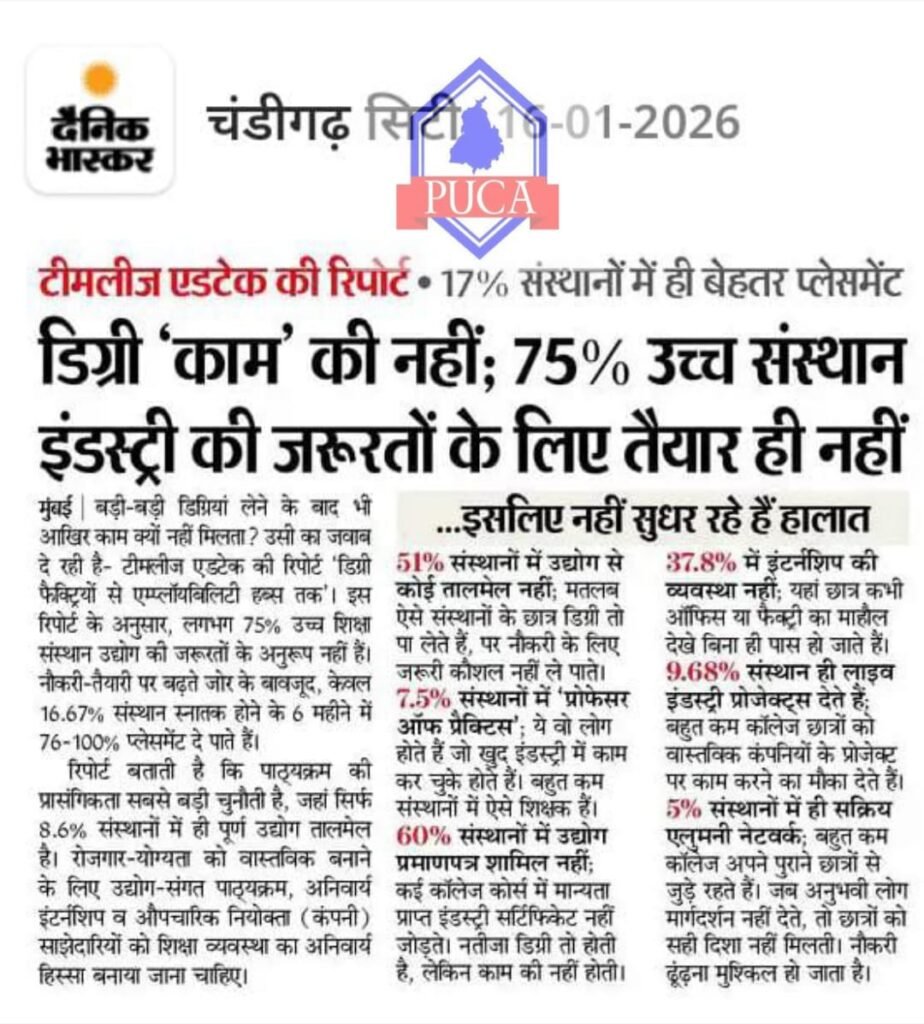
- 75% of higher education institutions are not aligned with industry needs
- 51% have no meaningful industry engagement
- Over 60% do not embed industry certifications
- Only 25% use live industry projects
- Less than 17% of institutions achieve 76–100% placements within six months
This is not a skills gap.
This is a system gap. from-degree-factories-to-employ…
At Lamrin Tech Skills University (LTSU), we acknowledged this gap from Day One—and chose to design education backwards from employability, not forwards from theory.
The National Problem: Why Degrees Are Losing Their Power
The report clearly highlights why traditional higher education is struggling:
1. Curriculum Misalignment
Only 8.6% institutions report full curriculum alignment with industry needs, while 51% remain completely unaligned. Students graduate with degrees but without job-ready skills.
2. Internship & Industry Exposure Deficit
- 37.8% institutions offer internships only to selected students
- 9.4% offer no internships at all
- Many students pass out without ever seeing a real workplace
3. Lack of Practitioner Faculty
Only 7.5% institutions regularly involve industry professionals in teaching—leading to outdated classroom learning disconnected from real-world practices.
4. Weak Employer & Alumni Networks
- Only 25% institutions report strong employer engagement
- 80% have underutilized alumni networks
5. Poor Placement Outcomes
Fewer than 1 in 5 institutions achieve high placement rates within six months—highlighting a serious employability crisis.
LTSU’s Foundational Belief: Education Must Lead to Outcomes
LTSU was never designed to be a “degree factory.”
It was built on one core principle:
Every program must result in employability, entrepreneurship, or career progression.
Instead of asking “What subjects should we teach?”
LTSU asks:
- What roles will students be hired for?
- What skills do employers demand today—not five years ago?
- What experience will make students productive from Day One?
How LTSU Is Addressing Every Gap Highlighted in the Report
1. Industry-Aligned Curriculum by Design (Not as an Add-On)
While most institutions talk about alignment, LTSU builds it into the curriculum structure:
- Curriculum co-designed with industry partners
- Continuous syllabus revision aligned with market demand
- Learning outcomes mapped directly to job roles and competencies
This directly counters the 75% misalignment problem identified in the report.
2. Mandatory Internships & On-the-Job Training for Every Student
Unlike institutions where internships are optional or selective, LTSU ensures structured work exposure for all students, including:
- Credit-linked internships
- Apprenticeships and live projects
- Industry immersion embedded within semesters
This responds to the report’s call to make employability a core academic outcome—not a peripheral function.
3. Learning from Practitioners, Not Just Professors
Only 7.5% institutions engage active industry professionals regularly.
At LTSU:
- Industry experts co-teach courses
- Practitioners mentor projects
- Real industry problems are brought into classrooms
Students don’t just learn concepts—they learn how those concepts are used in real jobs.
4. Embedded Industry Certifications Within Degree Programs
The report highlights that over 60% of HEIs do not embed industry certifications.
LTSU integrates:
- Skill-based certifications
- Digital, technical, and domain credentials
- Industry-recognized skill validation within the degree pathway
Students graduate with degrees + credentials + experience, not just transcripts.
5. Project-Based & Applied Learning as the Norm
While only 25% institutions frequently use live projects, LTSU makes applied learning mandatory:
- Industry projects every year
- Capstone projects linked to real companies
- Assessment based on problem-solving and execution—not rote exams
This ensures students graduate job-ready, not exam-ready.
6. Strong Employer & Alumni Integration
The report reveals that employer partnerships often lack depth.
LTSU treats employers and alumni as co-creators of employability:
- Employers shape curriculum and assessments
- Alumni act as mentors, recruiters, and guides
- Long-term partnerships replace one-time placement drives
This builds a sustainable employability ecosystem, not short-term hiring spikes.
From Intent to Execution: What Truly Sets LTSU Apart
The TeamLease report clearly states:
“The shift from degree factories to employability hubs is no longer optional—it is a leadership imperative.”
LTSU operationalizes this shift through:
- Institution-wide employability standards
- Skill-first program architecture
- Outcome-driven governance
- Continuous industry feedback loops
This is systemic transformation, not isolated initiatives.
The LTSU Promise to Students and Parents
At LTSU, a degree means:
✔ Industry-aligned learning
✔ Hands-on work experience
✔ Recognized skills & certifications
✔ Career readiness from Day One
✔ Clear pathways to employment or entrepreneurship
Conclusion: The Future Belongs to Employability-First Universities
India does not need more degree factories.
It needs employability hubs that prepare students for the real economy.
Lamrin Tech Skills University is not preparing students for exams.
It is preparing them for life, work, and leadership.
That is education with a difference.
That is the LTSU way.
