
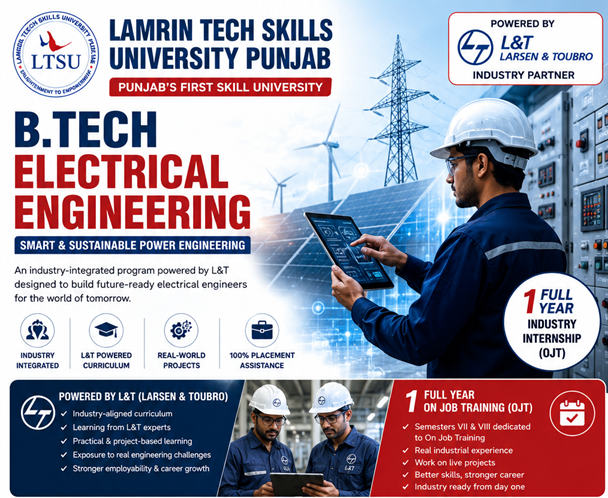
LTSU offers an industry-integrated B.Tech Electrical Engineering program developed with practical exposure and real-world applications.
Specialization:
Smart & Sustainable Power Engineering
Powered by L&T: Learn from One of the World’s Most Respected Engineering Companies
One of the biggest advantages of pursuing B.Tech Electrical Engineering at Lamrin Tech Skills University Punjab is its industry partnership with L&T (Larsen & Toubro), one of India’s largest engineering and technology companies.
L&T has played a significant role in shaping India’s infrastructure, power systems, automation projects, smart manufacturing facilities, transportation systems, and industrial development.
Through this industry-integrated model, students benefit from:
✔ Industry-aligned curriculum
✔ Exposure to real engineering challenges
✔ Project-based learning
✔ Industry expert interaction
✔ Practical problem-solving approach
✔ Career-focused training
Instead of learning only theoretical concepts, students gain knowledge that directly matches current industry requirements.
One Full Year Industry Internship (On Job Training)
Most engineering colleges offer internships lasting a few weeks or months.
At LTSU, students spend the entire Fourth Year in On Job Training (OJT) / On Job Deployment. Semesters VII and VIII are fully dedicated to industry exposure and practical learning.
This means students graduate with:
✔ Real industrial experience
✔ Professional workplace exposure
✔ Industry projects on their resume
✔ Better employability
✔ Stronger placement opportunities
By the time students complete their degree, they have already worked in real industrial environments, making them more job-ready than traditional engineering graduates.
Industry-Focused Subjects You Will Study
The curriculum has been carefully designed to cover both core electrical engineering concepts and emerging technologies.
First Year Foundation
- Applied Mathematics
- Programming for Problem Solving using C++
- Electrical and Electronics Engineering
- Engineering Graphics and Drafting
- Programming in Python
- Electrical Power Distribution and Automation
- Product Design Thinking Framework
- Applied Physics
These subjects help students build strong foundations in engineering, mathematics, coding, and problem-solving.
Second Year Industry Core Learning
- Network Analysis and Synthesis
- Digital System Design using Verilog
- Electrical Machines-I & II
- OH and UG Power Transmission Engineering
- Applied Industrial IoT
- High Voltage Engineering
- Power Systems Analysis
- Measurements and Instrumentation
- Microprocessors and Cyber Physical Systems for Industrial Applications
Students begin working with modern industrial technologies, automation systems, and intelligent electrical networks.
Third Year Advanced Power Engineering
- Renewable Energy and Power Evacuation
- Automatic Control Systems
- Power Electronics and Drives
- Power Generation and Economics
- Utilization of Electrical Energy
- Smart Grid Technologies and Infrastructure
- Power System Protection and Switchgear
- EHVAC and HVDC Transmission Systems
- Special Electrical Machines
These subjects prepare students for careers in renewable energy, electric mobility, power systems, industrial automation, and smart infrastructure.
Future-Oriented Elective Subjects
Students can further specialize through industry-relevant electives.
Power & Renewable Energy Electives
- Wind and Solar Energy Systems
- Power System Dynamics and Control
- Electrical Drives
Electric Vehicle & Smart Power Electives
- Electric and Hybrid Vehicle
- Flexible AC Transmission Systems
- Power System Reliability
Advanced Technology Electives
- Sensor Technology and Instrumentation
- Energy Efficient Systems
- Satellite Communication
- Active PWM Rectifiers
These electives ensure students remain aligned with future industry demands.
Unique Learning Model at LTSU
Unlike traditional engineering colleges, LTSU follows an industry-integrated approach.
Industry Collaboration with L&T EduTech
Students gain exposure to industry-designed curriculum, practical projects, and professional mentorship.
Real-World Projects
Students work on practical engineering problems instead of focusing only on theory.
Industry Exposure
Students interact with industry experts and gain understanding of current technologies.
Final Year On-the-Job Training (OJT)
The final year is dedicated to industry training, allowing students to gain hands-on experience before graduation.
Major Subjects Covered
Students study a combination of core electrical engineering and emerging technologies.
Core Subjects
- Electrical Machines
- Power Systems
- Circuit Theory
- Control Systems
- Power Electronics
- Electrical Measurements
- High Voltage Engineering
- Microprocessors
- Digital Electronics
Advanced Technologies
- Renewable Energy Systems
- Smart Grid Technology
- Electric Vehicle Technology
- Battery Management Systems
- Industrial Automation
- PLC & SCADA
- Embedded Systems
- IoT Applications
- Energy Storage Systems
Key Specialization Areas
Power Systems Engineering
Focuses on electricity generation, transmission, distribution, and grid management.
Career Roles:
- Power System Engineer
- Grid Engineer
- Transmission Engineer
Power Electronics & Drives
Deals with converters, inverters, motor drives, and energy-efficient systems.
Career Roles:
- Power Electronics Engineer
- Drive System Engineer
- Design Engineer
Renewable Energy Engineering
Focuses on solar, wind, hydro, and sustainable energy systems.
Career Roles:
- Solar Design Engineer
- Renewable Energy Consultant
- Wind Energy Engineer
Electric Vehicle Technology
One of the fastest-growing sectors worldwide.
Career Roles:
- EV Engineer
- Battery Systems Engineer
- Charging Infrastructure Engineer
Industrial Automation
Combines electrical systems with robotics and automation.
Career Roles:
- Automation Engineer
- PLC Engineer
- SCADA Engineer
- Robotics Engineer
Smart Grid Technology
Focuses on intelligent power networks and energy management systems.
Career Roles:
- Smart Grid Engineer
- Energy Systems Analyst
- Utility Technology Specialist
Top Companies Hiring Electrical Engineers
Core Electrical Companies
- Larsen & Toubro (L&T)
- Siemens
- ABB
- Schneider Electric
- Hitachi Energy
- Havells
- Crompton
- Bajaj Electricals
- GE Vernova
- Eaton
Power Sector Companies
- NTPC
- Power Grid Corporation of India
- NHPC
- Tata Power
- Adani Power
- Torrent Power
- Reliance Energy
Renewable Energy Companies
- ReNew Power
- Adani Green Energy
- Tata Power Solar
- Suzlon
- Vikram Solar
- Waaree Energies
Electric Vehicle Companies
- Tata Motors
- Mahindra Electric
- Ather Energy
- Ola Electric
- Hero Electric
- TVS Motor
- Bajaj Auto
Manufacturing Companies
- Bosch
- Mitsubishi Electric
- Daikin
- Samsung
- LG
- Panasonic
IT & Technology Companies
- TCS
- Infosys
- Wipro
- Accenture
- Cognizant
- HCL Technologies
Many electrical engineers today also build careers in software, AI, automation, and data-driven industries.
Job Opportunities in India
Graduates can work as:
- Electrical Design Engineer
- Power System Engineer
- Maintenance Engineer
- Automation Engineer
- Control Systems Engineer
- EV Engineer
- Renewable Energy Engineer
- Project Engineer
- Testing Engineer
- Quality Engineer
- R&D Engineer
- Embedded Systems Engineer
- Smart Grid Engineer
- Industrial Engineer
International Career Opportunities
Electrical Engineers are in demand across the globe.
Countries Hiring Electrical Engineers
- United States
- Canada
- Germany
- Australia
- United Kingdom
- UAE
- Saudi Arabia
- Qatar
- Singapore
- Norway
- New Zealand
International Roles
- Electrical Engineer
- Power Systems Engineer
- Design Engineer
- Automation Specialist
- Renewable Energy Engineer
- Project Manager
- Energy Consultant
- Grid Systems Engineer
- Maintenance Manager
- R&D Engineer
Global infrastructure and renewable energy projects continue to create significant demand for skilled electrical professionals.
Higher Education Options
After B.Tech Electrical Engineering, students can pursue:
- M.Tech Electrical Engineering
- M.Tech Power Systems
- M.Tech Renewable Energy
- M.Tech Control Systems
- M.Tech Electric Vehicles
- MBA
- MS Abroad
- Research Programs
- Government Engineering Services
Government Sector Opportunities
Electrical Engineers can prepare for:
- GATE
- PSU Recruitment
- Indian Railways
- State Electricity Boards
- NTPC
- Power Grid
- BHEL
- ISRO
- DRDO
- SSC JE
- UPSC Engineering Services
Why Choose LTSU for Electrical Engineering?
✔ Industry-integrated curriculum
✔ Collaboration with L&T EduTech
✔ Project-based learning
✔ Final Year Full-Time OJT
✔ Strong focus on employability
✔ Industry mentors and expert faculty
✔ Smart & Sustainable Power Engineering specialization
✔ Placement-oriented training
✔ Pay Half Program Fee After Placement model for eligible programs
