
The world is entering the Semiconductor Era.
Just like software transformed the world in the last two decades, semiconductor technologies are now becoming the backbone of every modern innovation — from Artificial Intelligence and Electric Vehicles to Smartphones, Defense Systems, Robotics, IoT, 5G, Healthcare Devices, Space Technology, and Smart Manufacturing.
In 2026, choosing B.Tech Electronics with specialization in VLSI Design & Semiconductor Technologies is not just another engineering option — it is one of the most future-proof and high-growth career choices in India and globally.
What is Semiconductor Technology?
Semiconductors are tiny electronic chips that power almost every digital device around us.
Your:
- Smartphone
- Laptop
- Smart TV
- Car
- ATM Machine
- Medical Equipment
- Satellite
- AI Server
- Defense System
—all run on semiconductor chips.
Without semiconductors, the modern digital world simply cannot function.
Countries today consider semiconductor manufacturing a matter of national importance and technological independence.
Why Semiconductor Industry is Growing Rapidly
The demand for semiconductor chips is exploding because of:
1. Artificial Intelligence (AI)
AI systems require extremely powerful processors and GPUs. Companies are investing billions in AI chips and accelerator technologies.
2. Electric Vehicles (EV)
Modern EVs use thousands of semiconductor components for battery management, sensors, automation, infotainment, and autonomous driving.
3. 5G & Telecom
The expansion of 5G networks requires advanced communication chips and embedded semiconductor systems.
4. Internet of Things (IoT)
Smart homes, smart factories, wearable devices, and industrial automation all depend on semiconductor technologies.
5. Defense & Space Technology
Countries are heavily investing in indigenous semiconductor ecosystems for strategic and defense applications.
Why India is Becoming a Global Semiconductor Hub
For decades, semiconductor manufacturing was concentrated in countries like Taiwan, South Korea, China, and the USA. But now India is emerging as a major semiconductor destination.
The Government of India launched the India Semiconductor Mission (ISM) with massive incentives to attract global chip companies.
India is now witnessing:
- Semiconductor fabrication plants (FABs)
- ATMP/OSAT packaging units
- Chip design centers
- VLSI R&D hubs
- Electronics manufacturing clusters
Industry experts estimate India’s semiconductor ecosystem could create up to 1 million jobs by 2026–27 across fabrication, design, testing, packaging, and supply chain operations.
Major Semiconductor Investments Happening in India
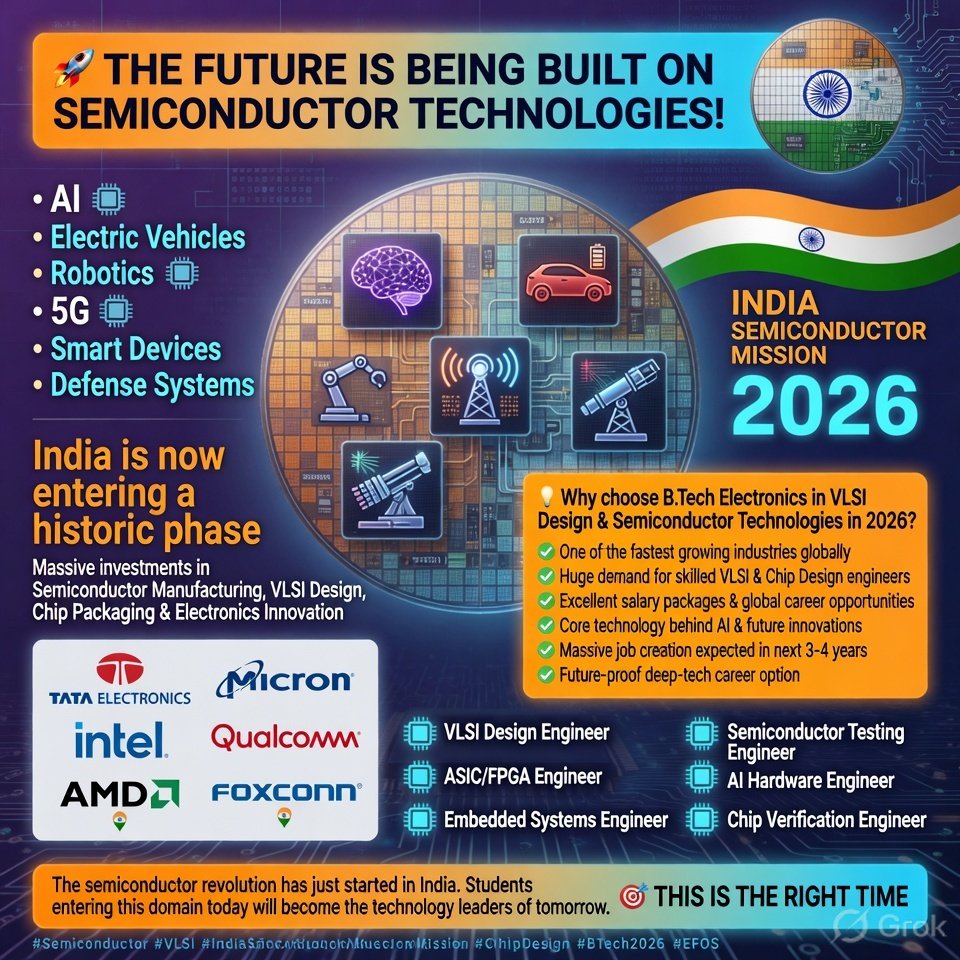
Several global and Indian companies are investing billions of dollars into semiconductor manufacturing and VLSI ecosystems.
Key Companies Investing in India
Tata Electronics + PSMC
Tata Electronics is building India’s first large semiconductor fabrication facility in Gujarat with Taiwan’s PSMC.
Micron Technology
Micron has already operationalized its semiconductor assembly and testing facility in Gujarat.
Intel + Tata Partnership
Intel and Tata Group announced strategic collaboration for semiconductor manufacturing and packaging in India.
Foxconn + HCL
Foxconn and HCL are developing semiconductor facilities in Uttar Pradesh focused on display driver chips.
Kaynes Semicon & CG Power
These companies are setting up advanced OSAT and semiconductor packaging units under the India Semiconductor Mission.
India’s semiconductor production capacity is expected to increase dramatically by 2026–27 as new plants become operational.
What is VLSI Design?
VLSI stands for:
VLSI=Very Large Scale Integration\mathrm{VLSI}
VLSI technology is used to design integrated circuits (ICs) by combining millions or even billions of transistors into a single chip.
VLSI engineers design:
- Microprocessors
- AI chips
- Mobile processors
- Memory chips
- Automotive electronics
- Embedded systems
- Communication processors
VLSI is the core of semiconductor innovation.
Why B.Tech Electronics in VLSI Design is a Smart Choice in 2026
1. High Demand, Low Supply
India currently has a shortage of highly skilled semiconductor and VLSI engineers. Companies are aggressively hiring specialized talent.
Core VLSI skills account for nearly half of semiconductor job openings in India’s design ecosystem.
2. Excellent Salary Potential
Top semiconductor companies offer some of the highest engineering salaries in India.
Companies like:
- NVIDIA
- Intel
- Qualcomm
- AMD
- Texas Instruments
- Samsung Semiconductor
- Broadcom
are actively hiring VLSI engineers in India.
Fresh VLSI engineers at leading firms can receive highly competitive salary packages depending on skill level and specialization.
3. Global Career Opportunities
Semiconductor engineering is a globally transferable skill.
Countries actively hiring semiconductor talent include:
- USA
- Taiwan
- Germany
- Singapore
- South Korea
- Japan
A strong VLSI background opens international career opportunities.
4. Future-Proof Career
Software technologies change rapidly, but semiconductor engineering remains a foundational technology for decades.
Emerging technologies such as:
- AI Chips
- Quantum Computing
- 3D Chip Design
- Edge Computing
- Automotive Electronics
- Robotics
- Advanced Packaging
will continue driving semiconductor demand for the next 20–30 years.
Job Opportunities in the Next 3–4 Years
The next few years are expected to create huge employment opportunities across the semiconductor ecosystem.
Major Career Roles
Design & Development
- RTL Design Engineer
- Physical Design Engineer
- Verification Engineer
- FPGA Engineer
- ASIC Engineer
- Analog Layout Engineer
Manufacturing & Testing
- Process Engineer
- Packaging Engineer
- Yield Engineer
- Testing Engineer
- ATMP/OSAT Engineer
Embedded & System Roles
- Embedded Systems Engineer
- Firmware Developer
- IoT Engineer
- Automotive Electronics Engineer
Research & Advanced Technologies
- AI Hardware Engineer
- Chip Architect
- Semiconductor R&D Engineer
Skills Students Should Learn
To build a strong semiconductor career, students should focus on:
- Digital Electronics
- Analog Electronics
- CMOS Design
- Verilog / VHDL
- FPGA Programming
- Embedded Systems
- Semiconductor Physics
- Python & Automation
- AI Hardware Basics
- EDA Tools (Cadence, Synopsys, Mentor Graphics)
The Future of Semiconductor Technologies
The semiconductor industry is expected to become one of the most strategically important industries in the world.
Future growth areas include:
- AI processors
- Quantum chips
- Autonomous vehicle electronics
- Smart factories
- Defense electronics
- 6G communication systems
- Advanced medical electronics
- Edge AI devices
India is positioning itself as a major player in this global transformation.
Students entering this field in 2026 will become part of one of the fastest-growing technology revolutions of the decade.
Conclusion
The future belongs to countries and professionals who can build advanced technologies — and semiconductors are at the center of that future.
Choosing B.Tech Electronics in VLSI Design & Semiconductor Technologies in 2026 is not just about getting a degree. It is about entering an industry that will define the next generation of innovation, manufacturing, AI, and digital infrastructure.
For students looking for:
- High-growth careers
- Strong salaries
- Global opportunities
- Future-proof technology domains
- Deep-tech innovation
Semiconductor technology and VLSI design offer one of the best career paths of the coming decade.
India’s semiconductor revolution has just begun — and this is the right time to become part of it.
