
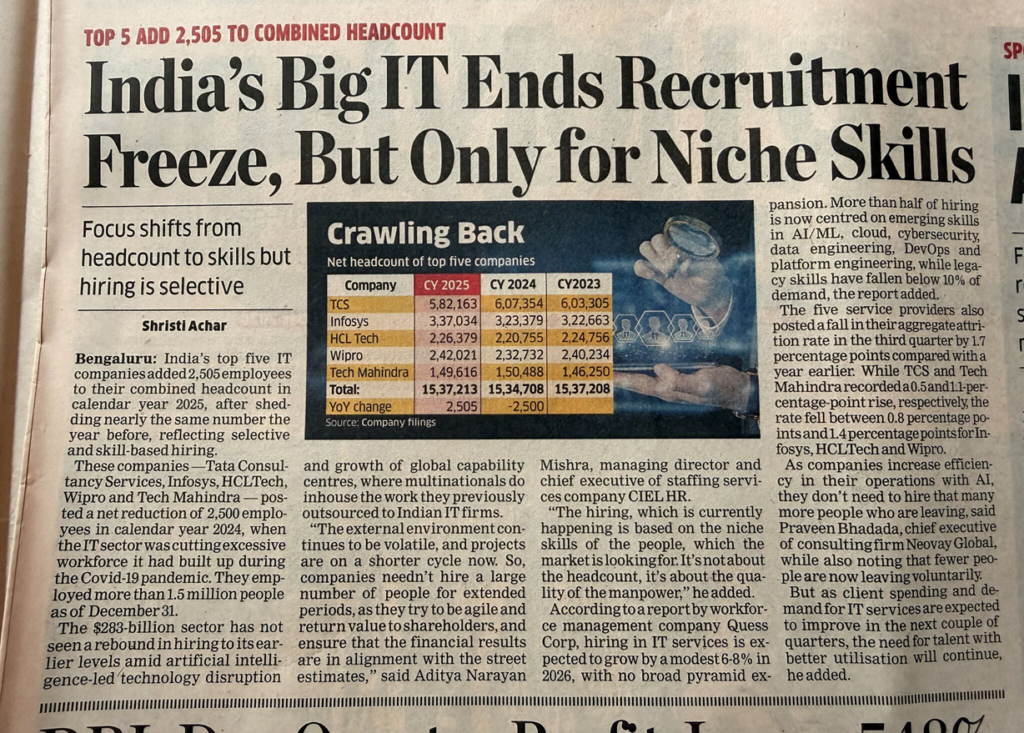
Recent headlines clearly signal a structural shift in India’s job market:
IT recruitment is no longer about mass hiring — it is about selective, niche skills.
Leading IT companies have slowed down large-scale recruitment and are hiring only for very specific, high-impact roles such as AI/ML, cybersecurity, cloud architecture, and advanced data engineering. Routine IT roles are increasingly automated, outsourced, or replaced by AI-driven systems.
This reality forces students and parents to ask an important question:
If traditional IT hiring is shrinking, where should future engineers invest their education?
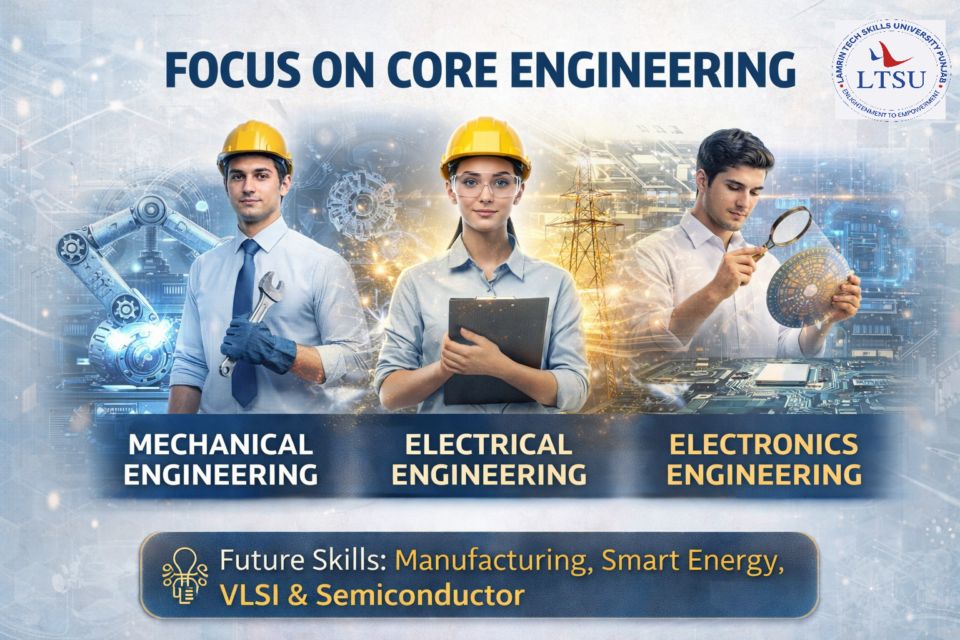
The answer lies in core engineering disciplines — Mechanical, Electrical, and Electronics — integrated with Industry 4.0, AI, and real manufacturing exposure.
Why Core Engineering Is Making a Strong Comeback
While IT hiring has become selective, manufacturing, infrastructure, power, electronics, and industrial automation are seeing long-term, sustainable demand.
Unlike pure software roles:
- Core engineering jobs cannot be fully automated
- Physical systems still need human-led design, maintenance, and innovation
- India’s focus on Make in India, semiconductor manufacturing, EVs, renewable energy, and smart factories is accelerating demand
Core engineers are required for:
- Digital manufacturing & smart factories
- Power systems & sustainable energy
- Electronics, VLSI & semiconductor design
- Industrial automation, robotics & CPS (Cyber-Physical Systems)
Industry-Integrated Engineering: The LTSU Advantage
At Lamrin Tech Skills University (LTSU), engineering education is reimagined for employability, not just degrees.
LTSU offers industry-integrated B.Tech programs in collaboration with L&T EduTech, ensuring students learn directly from industry leaders.
Why LTSU’s Model Is Different
- Curriculum designed with real manufacturing & engineering needs
- Training by L&T industry experts
- One full year of paid On-the-Job Training (OJT/OJD)
- Exposure to live industrial projects
- Strong placement pathways in leading manufacturing and engineering firms
- Half Fee – Pay After Placement model to reduce financial burden
This model bridges the biggest gap in Indian education:
the gap between classroom learning and industry readiness.
B.Tech Mechanical Engineering
Digital Manufacturing using AI & CPS
Duration: 4 Years (3 Years Academics + 1 Year OJT/OJD)
Eligibility:
- 10+2 (Non-Medical) with minimum 60%
- Minimum 60 percentile in JEE / CUET
What Makes It Future-Ready?
- Smart factories & Industry 4.0
- AI-driven manufacturing systems
- Cyber-Physical Systems (CPS)
- Robotics, automation & digital twins
- Real-world exposure through L&T-led training
Career Opportunities:
- Manufacturing Engineer
- Automation & Robotics Engineer
- Smart Factory Engineer
- Industrial AI Specialist
B.Tech Electrical Engineering
Smart & Sustainable Power Engineering
Duration: 4 Years (3 Years Academics + 1 Year OJT/OJD)
Eligibility:
- 10+2 (Non-Medical) with minimum 60%
- Minimum 60 percentile in JEE / CUET
What Makes It Future-Ready?
- Smart grids & power electronics
- Renewable energy systems
- EV charging infrastructure
- AI-enabled power management
- Sustainable and green energy technologies
Career Opportunities:
- Power Systems Engineer
- Renewable Energy Engineer
- EV Infrastructure Specialist
- Smart Grid Engineer
B.Tech Electronics Engineering
VLSI Design and Technology
Electronics is at the heart of India’s semiconductor and chip manufacturing mission.
Key Focus Areas:
- VLSI design & fabrication
- Semiconductor technology
- Embedded systems
- Hardware-software co-design
- Electronics for AI, IoT & automation
Career Opportunities:
- VLSI Design Engineer
- Semiconductor Engineer
- Embedded Systems Engineer
- Electronics R&D Engineer
Why This Matters for Students Today
The job market message is clear:
Mass IT hiring is over. Skill-first, industry-driven hiring has begun.
Students who:
- Choose core engineering
- Learn AI + manufacturing + electronics
- Gain real industrial exposure
…will remain employable not just today, but 10–20 years into the future.
Final Thought: Build Skills That AI Cannot Replace
Software changes fast. Tools change faster.
But core engineering + human problem-solving + real-world systems create careers that last.
At Lamrin Tech Skills University, with L&T EduTech as an industry partner, students don’t just earn degrees —
they build careers rooted in reality, relevance, and resilience.
👉 The future belongs to engineers who can design, build, power, and innovate the real world.
